
Top 10 Questions Churches Have About Live Streaming

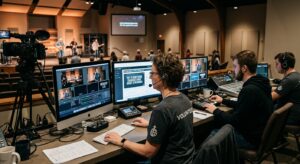
I work at StreamingChurch.tv and when churches explore or re-evaluate live streaming, their questions usually boil down to four main pillars: purpose, budget, technology, and copyright compliance.
Whether you’re launching your first stream or upgrading your current setup, here are clear, actionable answers to the top ten questions churches ask—plus an essential note on whether 4K streaming is worth the jump.
1. “Why are we streaming in the first place?”
Churches often struggle to define the primary purpose of their stream. Is it intended as a digital front door for prospective visitors, a lifeline for shut-ins and traveling members, or an online campus built for global engagement? Defining your primary objective shapes your strategy, budget, and platform choice from day one.
2. “How much internet bandwidth do we actually need?”
Unstable internet is the #1 cause of buffering and dropped streams. The key is upload speed, not download speed. Churches need a dedicated, wired connection (avoid Wi-Fi) with a consistent upload speed of at least 10–15 Mbps for a reliable 1080p HD broadcast.
3. “What streaming licenses do we need for worship music?”
Standard CCLI licenses cover physical congregational singing and lyrics on screen, but they do not automatically cover digital broadcasting. To avoid copyright strikes, muted audio, or taken-down streams, churches need specialized streaming licenses (such as CCLI Streaming License or OneLicense with streaming rights) when broadcasting cover songs, backing tracks, or pre-recorded clips.
4. “How do we get clear audio for the online stream?”
A mix that sounds full in the worship center often sounds quiet, muffled, or instrument-heavy on a phone or laptop. Getting clear online audio usually requires setting up a separate auxiliary (Aux) mix or a dedicated digital broadcast audio workflow tailored specifically for home speakers and headphones.
5. “Should we use free platforms or a dedicated ministry host?”
Free platforms like YouTube and Facebook offer broad reach, but they come with algorithmic distractions, competitor ads, strict copyright flags, and zero privacy control. Embedding a stream on your own website via a dedicated church platform provides a distraction-free environment, custom branding, integrated giving, and direct community engagement tools.
Pro Tip: Many churches choose a hybrid approach—broadcasting to social media for reach, while embedding their primary stream on their website for dedicated engagement.
6. “What hardware and software do we need to get started?”
The gear required ranges from a simple single-camera setup to a multi-camera production switcher. The main technical decision comes down to using software encoders (like OBS Studio or vMix on a PC/Mac) versus dedicated hardware encoders (like Blackmagic or AJA standalone units). Hardware encoders offer rock-solid reliability, while software options offer greater graphical flexibility.
7. “How do we engage online viewers so they aren’t just passive spectators?”
Without intentional design, a stream easily turns into digital TV where viewers watch passively. To foster true participation:
- Assign dedicated online hosts to greet viewers in the chat.
- Offer live, private prayer rooms.
- Share digital sermon notes, interactive connection cards, and links to online giving.
8. “How can non-technical volunteers run this on Sunday morning?”
Since most media teams rely on volunteers, workflows must be simple and predictable. Build repeatability into your workflow using preset camera angles, automated stream scheduling, and standardized step-by-step cheat sheets. The goal is a setup that any volunteer can confidently operate without needing a professional engineer on-site.
9. “Does live streaming encourage people to stop attending in person?”
This is a common concern for church leadership. However, research and practical experience show that streaming primarily acts as a front door for new visitors and a continuous bridge for the sick, homebound, or traveling members. Rather than cannibalizing attendance, a stream lowers the barrier for newcomers to check out your church before walking through the doors.
10. “How do we measure whether our stream is actually successful?”
Look beyond raw view counts, which can be misleading vanity metrics. True measurement focuses on:
- Average watch time: Are viewers staying for the message or dropping off after two minutes?
- Estimated real audience: Factoring in multiple viewers per device.
- Spiritual engagement: Tracking submitted digital connection cards, prayer requests, online giving, and follow-up conversations.
Bonus: What About 4K Streaming?
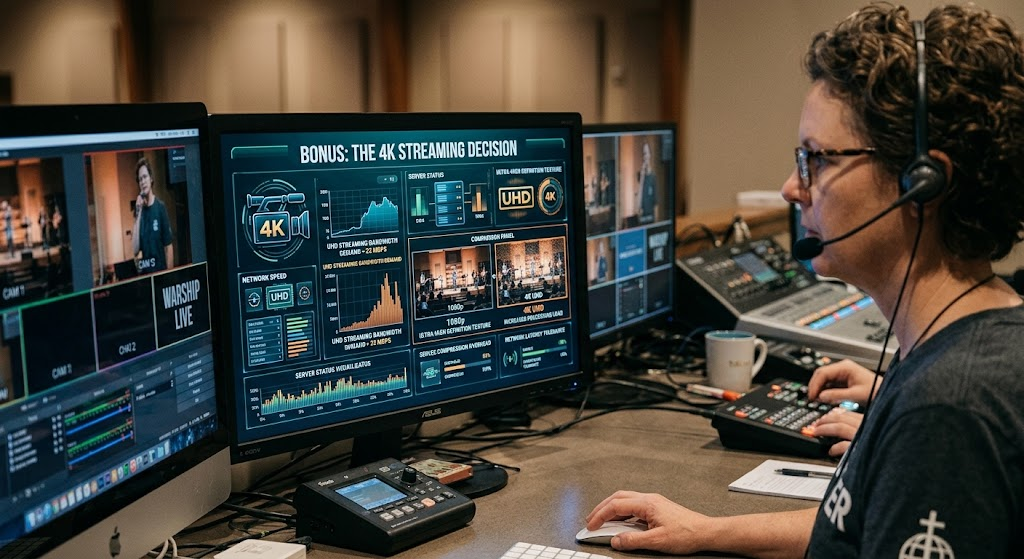
While 4K video sounds like a high-tech upgrade, it is rarely necessary or practical for churches today:
- Bandwidth Demands: 4K requires massive upload speeds (25–50+ Mbps steady) and high-end processing hardware.
- Viewer Limitations: Most online viewers watch on mobile devices or standard computer monitors where the visual difference between crisp 1080p HD and 4K is negligible.
- Platform Support: Many streaming platforms automatically compress video anyway.
The Bottom Line: Focus your resources on crisp 1080p video, excellent audio, and clear lighting before considering 4K.
More Questions? Happy to help, you can go to StreamingChurch.tv and chat and and/or schedule a time to speak with Phil Thompson here.
You can also listen or watch Steve lacy and Phil Thompson talk about this topic as well as other on the Church Solutions Podcast.